The stave churches of Norway
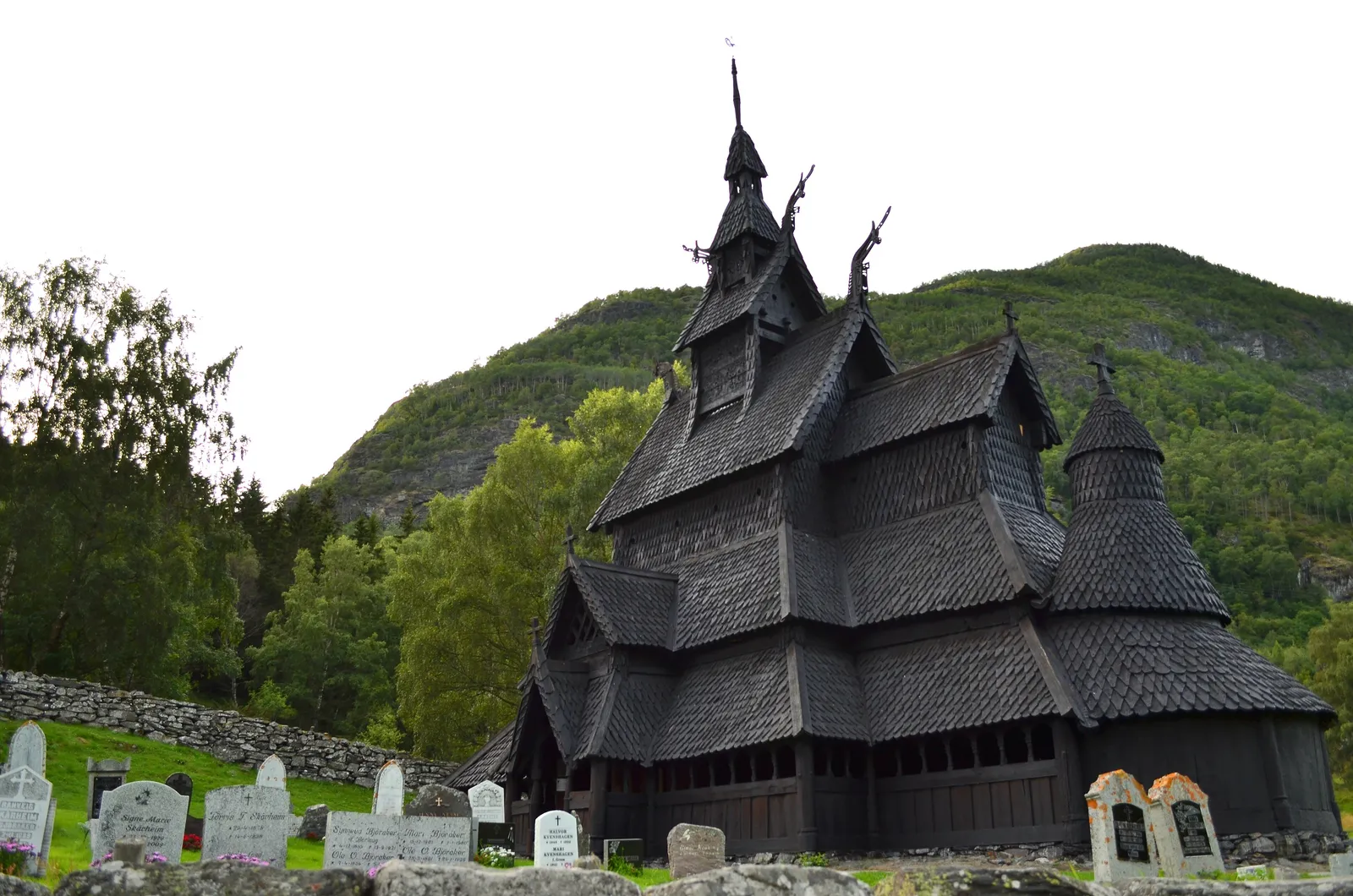
Photo: Mxjanier, CC BY-SA 3.0

Picture a church built entirely of wood some 850 years ago, its roofs stacked one above the other like a pagoda, dragon heads snarling from the gables. That is a Norwegian stave church, and Store norske leksikon calls them Norway’s most important contribution to European architecture. They are also, it says, the oldest surviving wooden churches in Christendom.
What makes it a “stave” church
The name comes from the Old Norse word stafr, a post, as the Directorate for Cultural Heritage (Riksantikvaren) explains. The staves are the big load-bearing posts of the frame. The earliest churches had their posts dug straight into the ground, which rots wood. The fully developed design solved that: a frame of heavy sill beams rests on stones, the corner staves stand on the sills, a second frame ties them together at the top, and the wall planks are slotted in between. A steep roof rises above it all.
The builders were patient. According to Store norske leksikon, they used dry, resin-rich pine, made by stripping the bark or cutting the tops off living trees and leaving them standing to dry for a few years before felling. In the more elaborate churches, a tall central room rises on free-standing posts above a lower aisle, a wooden version of the stone basilicas of Romanesque Europe.
Thousands built, 28 left
Nobody knows exactly how many there were. Store norske leksikon says at least 750, probably many more; Riksantikvaren puts the total at between 1,000 and 2,000, with probably just under 1,000 standing around 1350. On what survives, the main authorities agree: 28 stave churches are preserved in more or less complete form, the count used by Riksantikvaren, Store norske leksikon, UNESCO and the churches’ owners. (One leksikon article, on Urnes, says 29, so you will see both numbers.) Copies such as the new Fantoft church aren’t counted.
None survives north of Trondheim, Riksantikvaren notes, and with a few exceptions Norway is the only country where stave churches still stand where they were built. Why did so many go? Store norske leksikon notes that from the mid-1200s builders moved to a simpler frame, and that the large cross-shaped churches built that way, above all in Møre, are all long gone, perhaps because they were weaker. Others were replaced in the 1800s: Borgund got a new parish church beside it around 1870, and Gol’s stave church was to be pulled down in 1881. The landscape painter J. C. Dahl was the first to see what they were worth. After him, the Society for the Preservation of Norwegian Ancient Monuments (Fortidsminneforeningen) set out to save them and bought eight.
Four to know
Urnes, on the eastern shore of the Lustrafjord, is the only stave church on UNESCO’s World Heritage List, inscribed in 1979. Store norske leksikon regards it as Norway’s oldest surviving stave church, built in the early 1130s; its owner and UNESCO more cautiously call it one of the oldest. Its fame is the north wall and portal, reused from an earlier church: planks its owner dates to about 1070 (tree-ring dating puts the felling of one at 1070 or just after), carved with slender animals biting and twisting into one another. The carving gave its name to the Urnes style, the last of the Viking Age art styles.
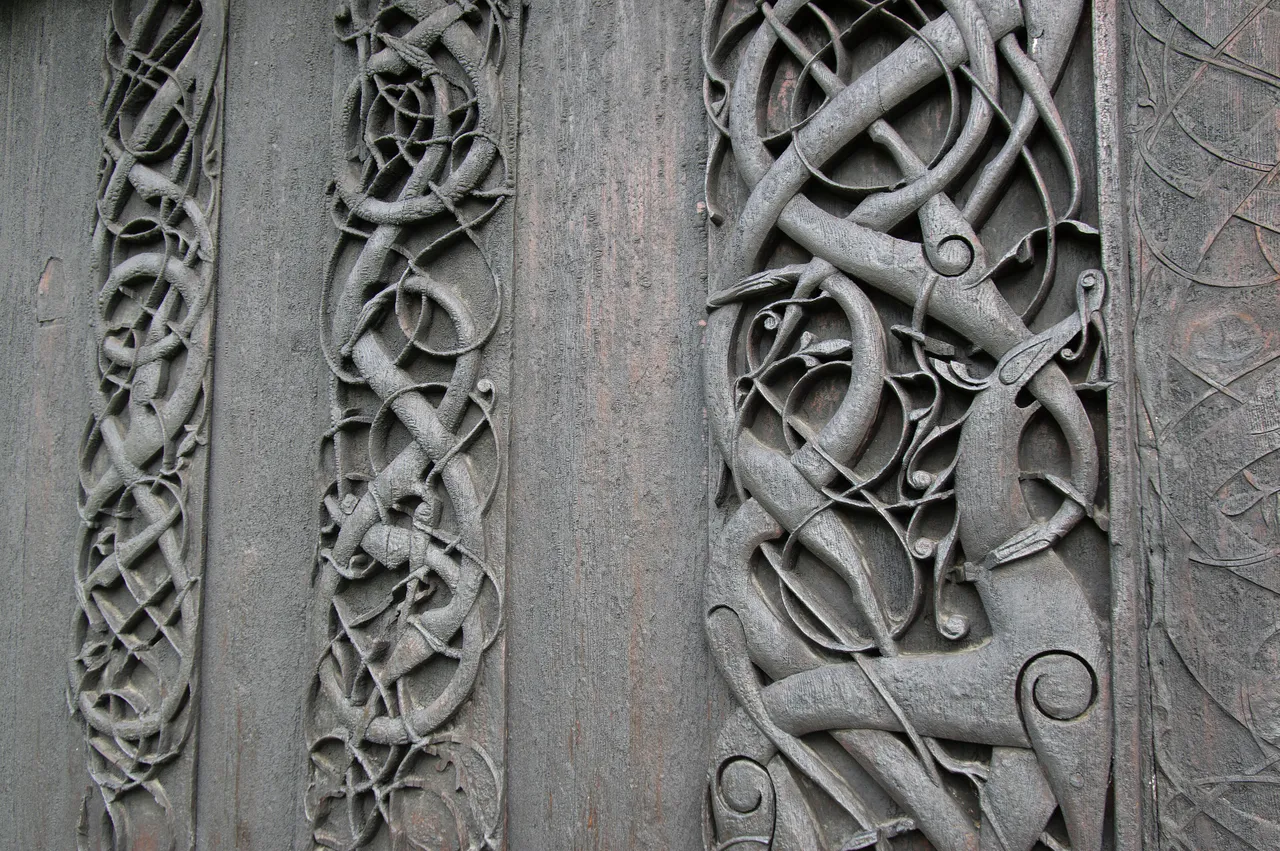
Photo: Bjørn Erik Pedersen, CC BY-SA 4.0

Borgund in Lærdal is the one on the postcards: seven roof levels, shingles like fish scales and dragon heads on the ridges. Tree-ring dating shows its timber was felled in the winter of 1180–81. Many regard it as the best preserved, say both Store norske leksikon and its owner, and it served as the model when Hopperstad, Fantoft and Gol were restored. Beside it stands a free-standing bell tower, the only stave-built one in Norway according to its owner. A copy of Borgund was even built in Rapid City, South Dakota, in the 1960s.
Heddal, five kilometres west of Notodden in Telemark, is the largest of all known stave churches in Norway, according to Store norske leksikon. Look closely, though: Store norske leksikon says two thorough restorations, in 1849–51 and one completed in 1955, replaced most of the original material. It is still a parish church.
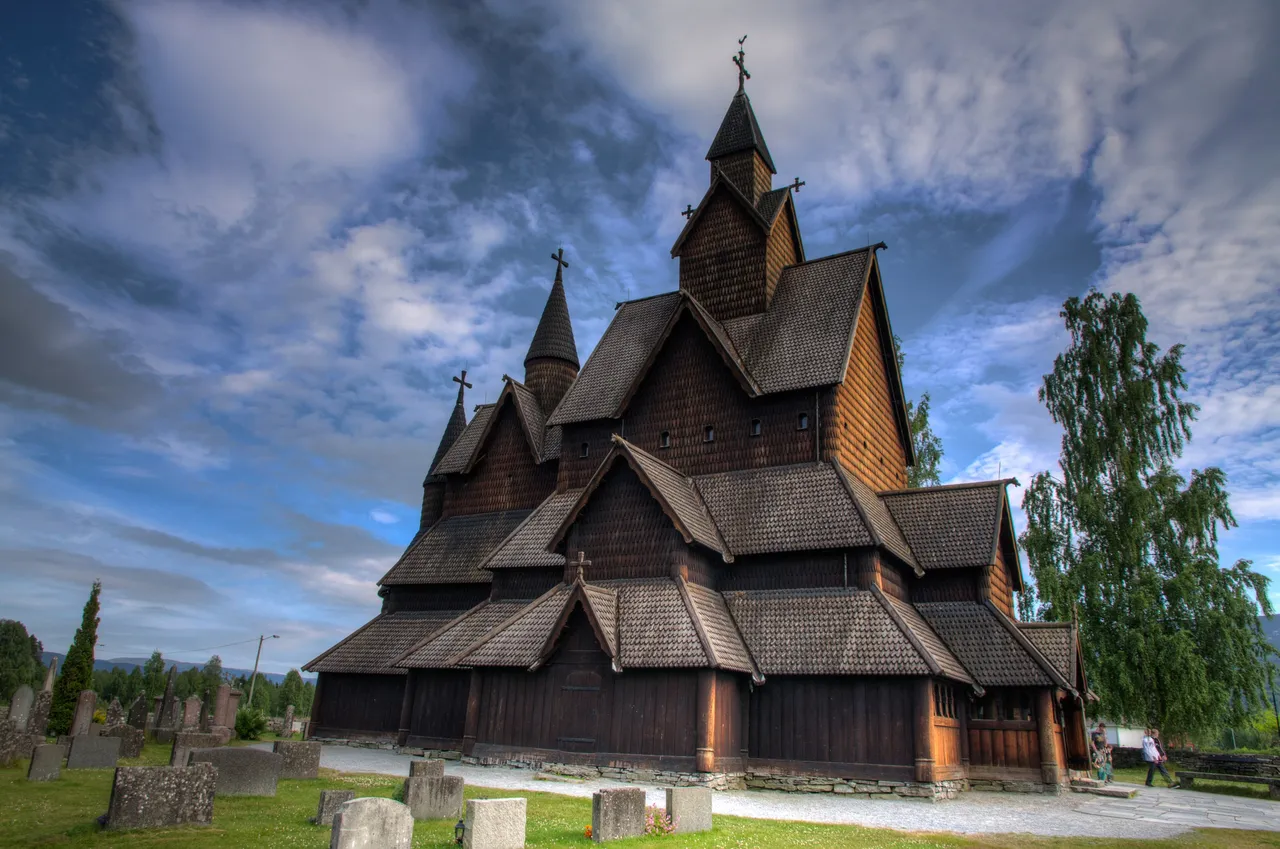
Photo: Christian Barth, CC BY-SA 3.0 no

Gol is the easiest to reach: it stands at the Norsk Folkemuseum on Bygdøy in Oslo. Built around 1200 in Hallingdal, according to the museum, it was taken down and rebuilt there in 1884, with Borgund as the model for the parts that had been lost. Gol has since built itself a copy, consecrated in 1994.
Moved, burned and rebuilt
Gol isn’t the only traveller. Haltdalen church was moved to the Trøndelag Folkemuseum at Sverresborg in Trondheim in 1937 (and re-erected there after the war), and Garmo is at Maihaugen in Lillehammer, a fairly free reconstruction from 1921. The most surprising journey was Vang’s: the church from Valdres was moved to what was then Prussia in 1842, and stands today in Karpacz, Poland.
The saddest story belongs to Fantoft, moved from Fortun in Sogn to the outskirts of Bergen in 1883. On 6 June 1992 it was set alight and burned almost to the ground. Store norske leksikon calls it the start of a wave of church fires in Norway: of around fifty fires and attempted arsons in that period, it estimates, about a third can be attributed to fans or figures of the Norwegian black metal scene. A man from that scene was charged with the Fantoft fire but acquitted by a divided court, NRK and Store norske leksikon report. The church was rebuilt as a copy, consecrated in 1997, and a former Bergen fire chief told NRK that many stave churches were fitted with sprinklers in the years that followed.
Riksantikvaren’s stave church programme from 2001 to 2015 then repaired all 28 churches at a cost of NOK 130 million. At Urnes the whole church was straightened up and given new foundations.
Visiting
Of the four above, only Gol can be seen all year; the others open in summer only. About half of all stave churches are still parish churches, Riksantikvaren says, so services and weddings can change opening times. Seasons for 2026, from the owners:
- Urnes (Fortidsminneforeningen): 2 May to 30 September, daily 10:30–17:45 (closed 17 May), adults NOK 150. Since the 2024 season no more than 50 people are allowed inside per hour, so expect a wait.
- Borgund (Fortidsminneforeningen): 15 April to 14 October, daily 09:30–17:00 (closed 17 May and 6–7 October; 10:00–14:00 on 14 October), adults NOK 150, with a visitor centre. No more than 20 people are let in at a time.
- Heddal (the parish): 18 May to 13 September, 10:00–16:00 (until 17:00 from 1 July to 16 August); on days with a service it opens at about 12:15. Adults NOK 110, tickets sold in the café. The church may be closed for weddings on Saturdays.
- Gol (Norsk Folkemuseum, Oslo): the museum is open all year except 1 January, 17 May and 24–25 December: daily 10:00–17:00 from 1 May to 4 October, Tuesday to Sunday 11:00–16:00 from 5 October to 30 April; adults NOK 200. From 5 October to 31 December 2026 a 30-minute guided tour in English of the stave church and a farmhouse is included in the ticket (no tours on Mondays).
Hours change from year to year, so check with the owner before you go. If you are driving between Oslo and Bergen, see Getting around.
Sources
- https://snl.no/stavkirke
- https://www.riksantikvaren.no/arbeidsomrader/stavkirker
- https://www.riksantikvaren.no/stavkyrkjene-vare
- https://whc.unesco.org/en/list/58/
- https://snl.no/Urnes_stavkirke
- https://snl.no/Borgund_stavkirke
- https://snl.no/Heddal_stavkirke
- https://snl.no/Gol_stavkirke
- https://snl.no/Fantoft_stavkirke
- https://snl.no/Haltdalen_stavkirke
- https://snl.no/Garmo_stavkirke
- https://snl.no/Vang_stavkirke
- https://fortidsminneforeningen.no/en/museum/urnes-stave-church/
- https://fortidsminneforeningen.no/en/museum/borgund-stave-church/
- https://www.heddalstavkirke.no/
- https://norskfolkemuseum.no/en/stave-church
- https://norskfolkemuseum.no/en/guided-tour-the-stave-church-and-the-hove-farmhouse
- https://norskfolkemuseum.no/en/plan-your-visit
- https://snl.no/black_metal
- https://www.nrk.no/vestland/25-ar-sidan-fantoft-stavkirke-brann-1.13546826