Hiking to Preikestolen
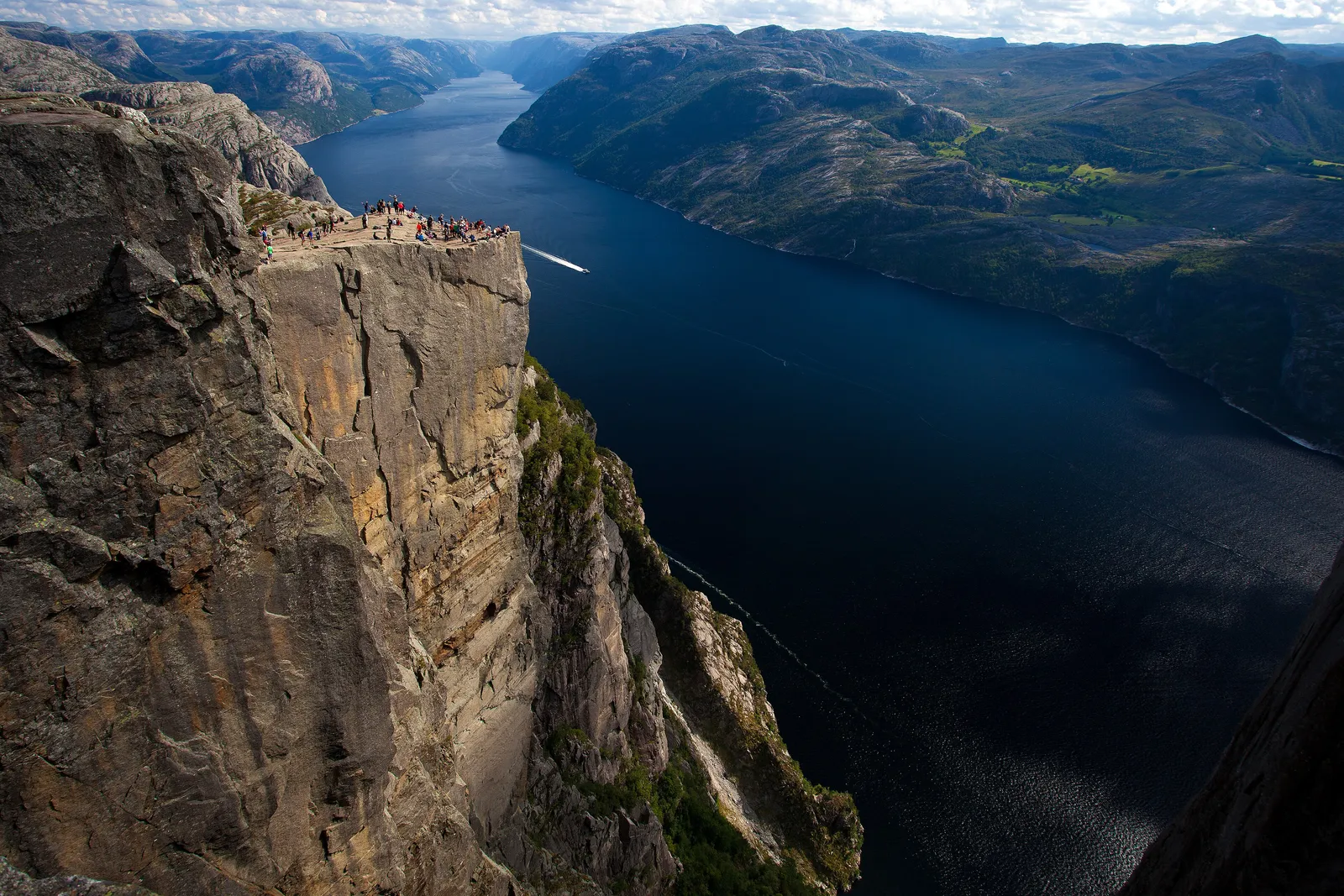
Photo: Svein Magne Tunli, CC BY-SA 4.0

Preikestolen (Pulpit Rock) is a flat-topped cliff, about 25 by 25 metres, that stands 604 metres above the Lysefjord in Ryfylke, east of Stavanger. It is a very popular hike: 348,000 people walked to the plateau in the summer of 2022 alone, according to Stiftelsen Preikestolen, the non-profit foundation of local municipalities and landowners that runs the car park and maintains the trail.
The walk itself is not technical, but it is a real mountain hike, and rescue teams are called out to it every year.
The trail
- Distance: 8 km there and back, on the same path.
- Time: about four hours in total, according to the foundation. Allow more with children, in wet weather or in winter.
- Climb: a total elevation gain of about 500 metres.
- Grade: moderate. Visit Norway says it requires some trekking experience in rough terrain.
The trail starts at Preikestolen BaseCamp (Preikestolen Fjellstue), by the car park. It crosses boggy ground and forest, and climbs steep stone staircases built by Nepalese Sherpas. It is marked with red T signs. The last stretch runs along high cliffs to the plateau; take particular care here if you have children with you.
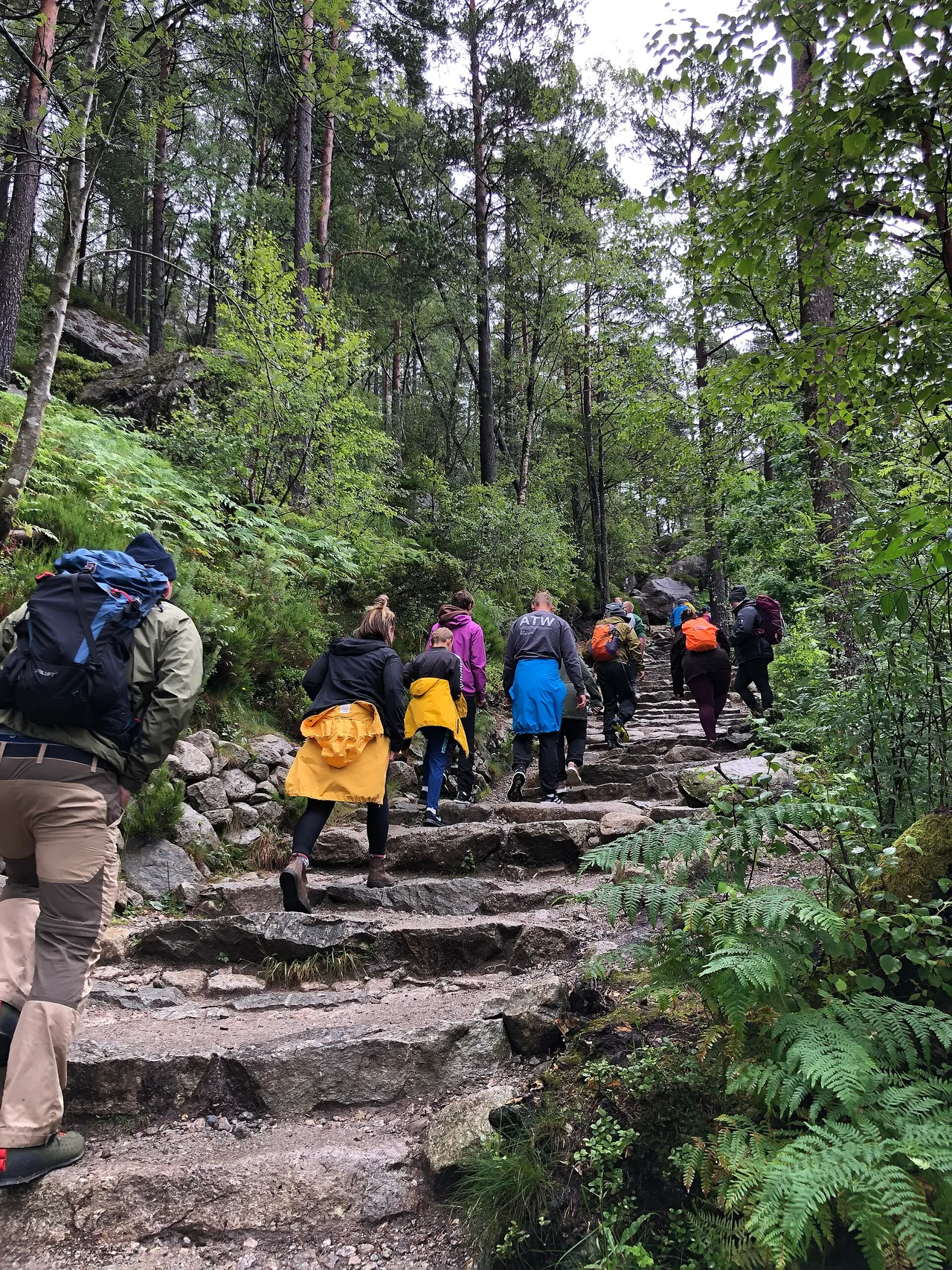
Photo: Davide Mauro, CC BY-SA 4.0

There are no toilets or rubbish bins along the trail. Use the toilets at the car park before you set off, and carry everything you bring back down with you.
Getting there
By car. The drive from Stavanger takes 30 to 40 minutes. Follow road 13 (signposted Røldal) through the Ryfylke Tunnel, leave it at Solbakk and continue on road 523 to Jørpeland. About three kilometres past Jørpeland, follow the signs to Preikestolen Parking. The old Stavanger–Tau car ferry closed when the tunnel opened in December 2019, so ignore older guides that still send drivers that way.
By bus, in season. Two companies run buses from Stavanger to the car park, taking 50 minutes to an hour. Their 2026 timetables:
- Pulpit Rock Tours, from Stavanger’s city bus terminal: two morning departures at weekends from 21 March to 30 April (daily over Easter, 30 March to 6 April), six a day from 1 May to 19 June and from 14 September to 4 October, nine a day from 20 June to 13 September, and two morning departures at weekends from 10 October to 1 November.
- Go Fjords, from the Radisson Blu Atlantic Hotel in Stavanger: two morning departures at weekends in April, May and September, two a day in June, and four a day in July and August.
Buy tickets online in advance, as you can’t buy them on the bus, and come back with the same company. Check current timetables with the operators.
Outside the bus season. The direct buses don’t run in the low season. BaseCamp recommends Kolumbus bus 100 from Stavanger to Jørpelandsvågen, then a taxi of about 10 minutes to the trailhead. See Getting around Norway for travel to Stavanger itself.
When to go
Visit Norway gives the hiking season as May to October. The foundation keeps the trail open all year, but conditions outside summer are very different (see below).
June, July and August are the busiest months, and Saturdays and Sundays the busiest days. In summer the trail is usually most crowded between 08:00 and 10:00. To avoid the queues, the foundation suggests starting before 08:00 or after 16:00; the long summer evenings give you time for a late start. The car park is busiest between 08:00 and 16:00, and when it is full you may be asked to wait a few hours, or to spend the time in Jørpeland.
From September to March the days are short. Start early enough to be back at the car park before dark.
Hiking outside summer
BaseCamp counts October to April as the winter season, when the path is often covered in ice and snow. Visit Norway says that from November to April you need special equipment and a guide. The foundation recommends a guided tour, especially in winter or if you are less experienced, and Region Stavanger’s Edge of Norway recommends professional guides off season.
If you go in winter:
- Wear warm hiking or mountain boots, wool next to the skin, several layers, a hat and mittens.
- Use ice cleats or spikes, especially when the car park staff tell you to. You can rent them, and poles with spikes, at BaseCamp’s Adventure Centre, which is open all year; you can’t book gear in advance, and don’t need to.
- Don’t take children under five, the foundation advises.
- Check the forecast and plan to finish in daylight.
Safety
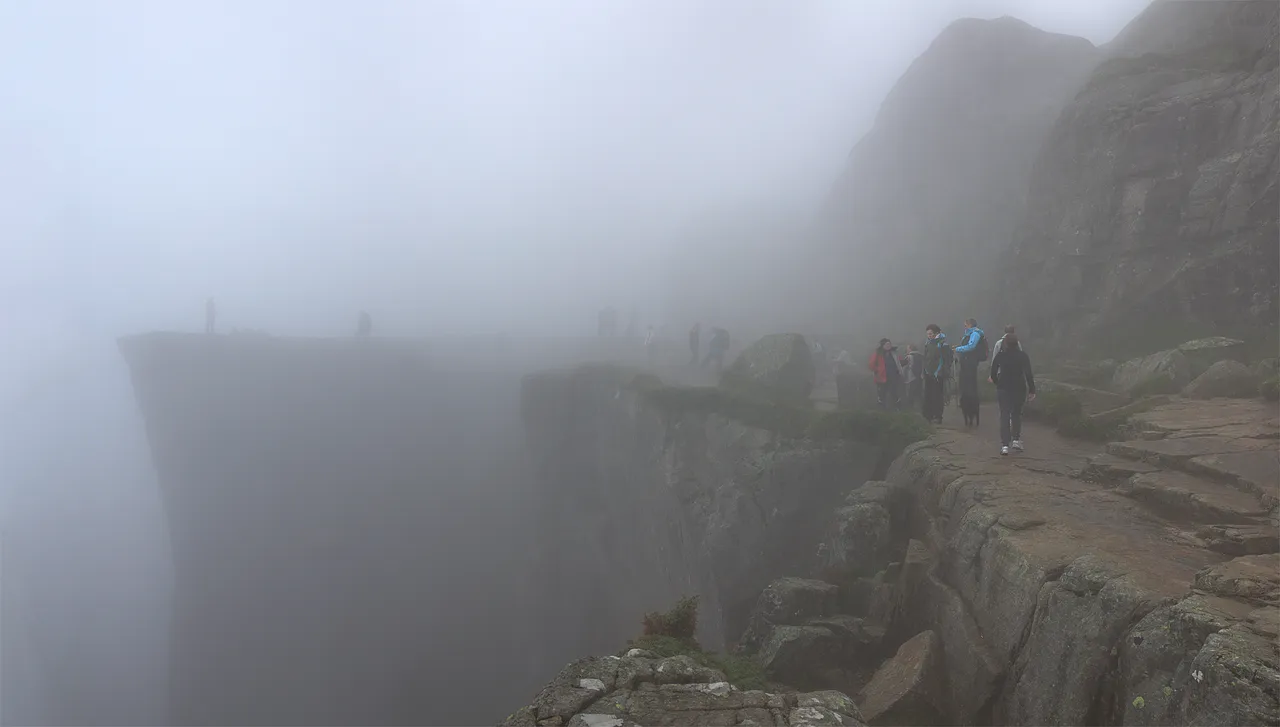
Photo: Åsmund Heimark, CC BY 2.0

Rescue volunteers from Norsk Folkehjelp Strand og Forsand know the Preikestolen trail well; in 2024 they were one of the teams with the largest increase in callouts, Norsk Folkehjelp says, as rescues grew at popular tourist hikes. In July 2024 the team’s emergency preparedness leader told TV 2 it had already passed 30 operations that year, and described hikers who lost their way in thick fog at night. Nationwide, most of Norsk Folkehjelp’s callouts come between 15:00 and 23:00, often in the dark.
- Check the weather. It can change quickly in the mountains; Visit Norway says to be prepared for bad weather and frost even on short trips. DNT points to yr.no for forecasts; BaseCamp has a webcam.
- Wear proper boots. The foundation recommends above-ankle, waterproof hiking boots; Visit Norway says trainers are not suitable for Norwegian mountain hikes.
- Bring waterproof and windproof clothing, extra layers, food and water, a map, a fully charged phone and a torch.
- Tell someone your plans and when you expect to be back. The car park is staffed all year: ask about conditions and listen to the staff’s advice.
- Stay on the marked trail, follow the red T markings, take great care along the cliffs, and keep dogs on a lead at all times.
- Turn back in time. The Norwegian Mountain Code (Fjellvettreglene) puts it simply: there is no shame in turning back.
In an emergency, call 113 (medical emergencies); 112 is the police and 110 the fire service. Hiking at Preikestolen is at your own risk.
The foundation also asks visitors not to fly drones, build cairns or camp on the plateau. From 15 April to 15 September it is illegal anywhere in Norway to light a fire in or near forest and other open countryside, unless the municipality allows it or there is obviously no risk of fire.
Other ways to see it
- From the fjord. Rødne’s Lysefjord cruise leaves from Strandkaien in central Stavanger, all year, and takes 3 to 3.5 hours, passing below Preikestolen. Its published timetable has one departure a day, Thursday to Sunday, from October to March (daily from 25 to 31 December), one a day in April, two a day in May and September, and three a day from June to August. In October 2026 an adult ticket cost NOK 890.
- At sunrise. You can arrive at the car park at any time. A sunrise hike means walking up in the dark, so bring a head torch and warm clothes, and check sunrise times before you go.
- Kjerag. Further up the Lysefjord, the hike to Kjerag is much harder: about 11 km, 6 to 10 hours and 800 metres of climbing, with sections on wires. Its access road is open from around mid-May until October or November.
Good to know
- Parking at the trailhead has room for about 1,000 cars, in two car parks (P1 by BaseCamp and P2 Moslimyrå), both with toilets. Pay at the machine after your hike. In October 2026 it cost NOK 40 for up to two hours and NOK 275 for longer; parking is free for BaseCamp’s overnight guests.
- Staff are on site from 07:00 to 18:00 in summer and 09:00 to 14:00 in winter; the barriers and payment machines work around the clock.
- No camping or sleeping in vehicles at the car park. The foundation points campers to Preikestolen Camping, a few kilometres away.
- Staying overnight. BaseCamp has a mountain lodge, a tourist cabin, glamping and a beach cabin, which lets you start early.
- Wild camping. Norway’s Outdoor Recreation Act generally lets you pitch a tent in open countryside at least 150 metres from an inhabited house or cabin, for up to two days at a time without the landowner’s permission. At Preikestolen, the foundation asks you not to camp on the plateau itself.
Practical info
- Getting there
- Drive 30–40 minutes from Stavanger through the Ryfylke Tunnel, or take a Pulpit Rock Tours or Go Fjords bus (50 minutes to an hour, late March to early November in 2026, weekends only at the start and end). Off season, Kolumbus bus 100 to Jørpeland, then a taxi.
- Season
- May to October for most hikers. The trail is open all year, but from October or November to April expect ice and snow, and go with a guide.
- Cost level
- moderate
- Booking tips
- Book bus tickets online in advance and return with the same operator. Start before 08:00 or after 16:00 in summer to avoid the crowds and the full car park.
Sources
- https://preikestolen365.com/hiking-to-preikestolen/
- https://preikestolen365.com/parking-at-preikestolen/
- https://preikestolen365.com/how-to-get-to-preikestolen/
- https://preikestolenbasecamp.com/en/planlegg-reisen/
- https://www.visitnorway.com/places-to-go/fjord-norway/ryfylke/the-lysefjord-area/hiking-to-preikestolen/
- https://www.visitnorway.com/places-to-go/fjord-norway/ryfylke/the-lysefjord-area/hiking-to-kjerag/
- https://www.visitnorway.com/safe-travel/mountain-safety/
- https://www.edgeofnorway.com/en/destinations/preikestolen
- https://rodne.no/en/fjord-experiences/stavanger/fjordcruise-lysefjord-preikestolen/
- https://www.dnt.no/fjellvettreglene/
- https://folkehjelp.no/fagblad-sanitet/article/ny-aksjonsrekord-530-lete-og-redningsaksjoner-i-2024
- https://www.tv2.no/direkte/jpybz/siste-nytt/6687bd51bd22f2d594551c73/ligger-an-til-rekordmange-redningsaksjoner-ved-preikestolen
- https://lovdata.no/dokument/NL/lov/1957-06-28-16
- https://lovdata.no/dokument/SF/forskrift/2015-12-17-1710
- https://www.visitnorway.com/listings/hike-to-preikestolen-in-the-lysefjorden/238353/
- https://www.pulpitrock.no/tabeller.php
- https://gofjords.com/experiences/hiking/stavanger/preikestolen-express-bus-round-trip/
- https://www.ntnu.no/concept/rv13-ryfast-og-e39-eiganestunnelen